The Spring Bulbs Get underway
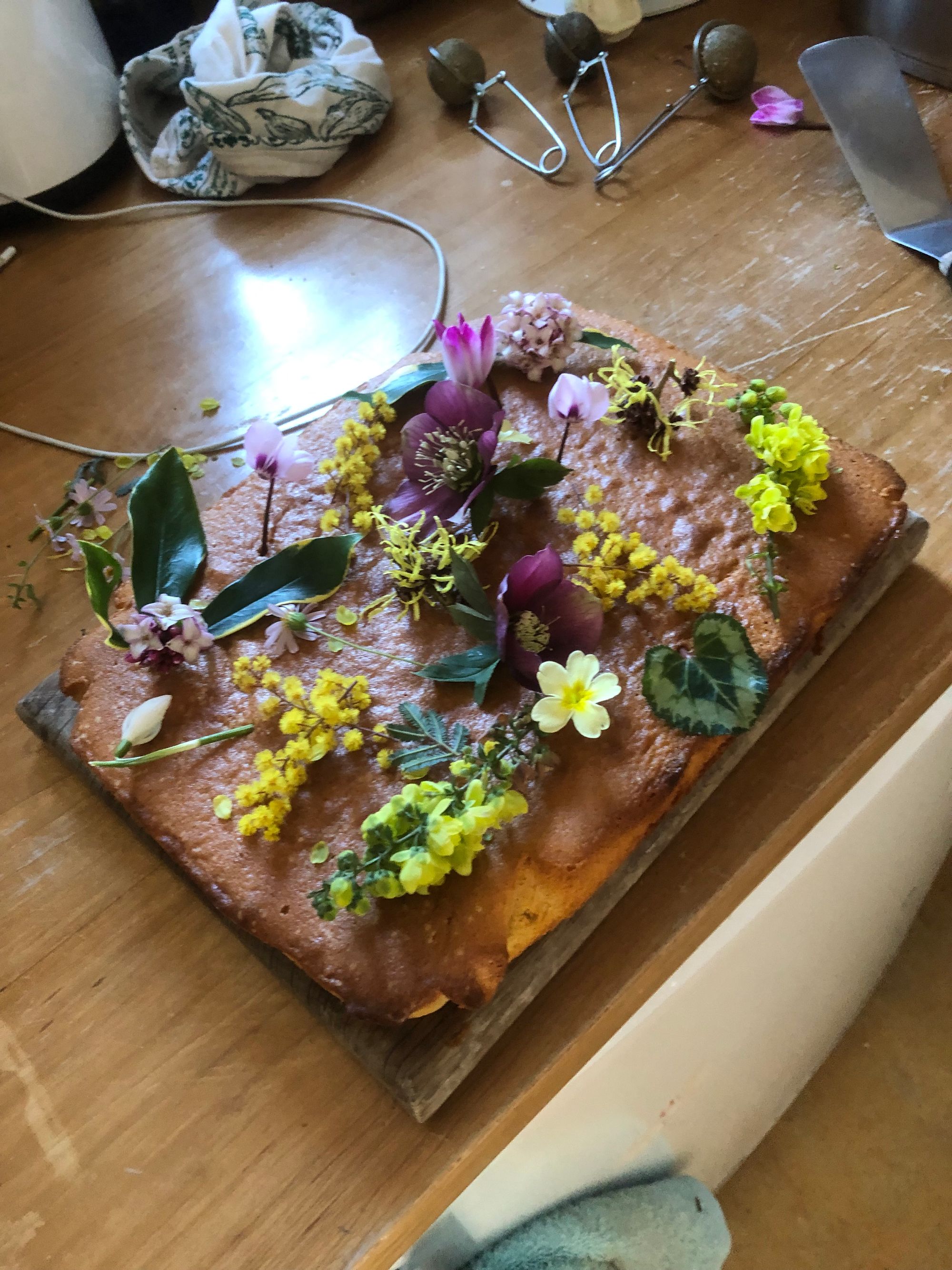
The great excitement of the end of January and early February is that Spring is in the air and every day sees new shoots poking through the grass. A brief walk around the house and crocuses have now joined the snowdrops. We planted 250 wild daffodils (Pseudonarcissus Lobularis) in the autumn and they are just poking their leaves through the grass. They grow freely in nearby meadows and in sheltered spots are already in bud. I expect ours will be late as we didn't get them into the ground until mid October. Janie created this cake for two friends' birthdays on 30th of January and it provides a good sample of what was flowering in the garden at the time.
If you look carefully, you will see acacia baileyeana, hamamelis pallida, mahonia, daphne, cyclamen, primrose, snowdrop and hellebore.
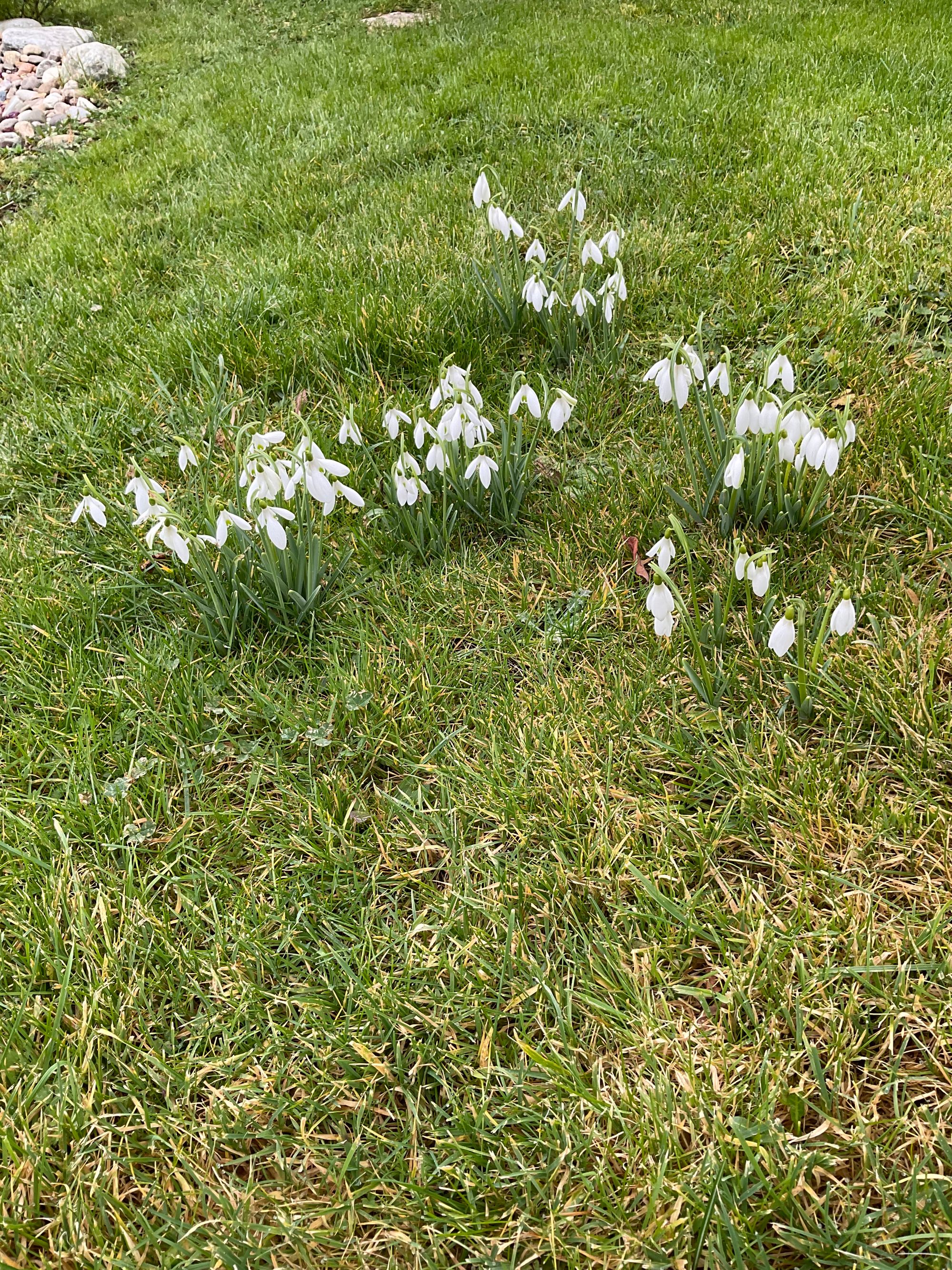
Other places daffodils can be seen growing wild are North Yorkshire (Farndale near Kirkby Moorside), the Welsh Marches, around Ross on Wye, and (I imagine it was Lobularis that inspired Wordsworth). Our snowdrops are multiplying, but they need to be seen in masses to be really effective. Snowdrop fanciers are a cult apart, paying eye-watering prices for rare cultivars, I don't think I would dare plant them out.Try Davidlculp.com, who offers 'Golden Fleece' for US$300. The correct word for a cult member is "galanthophile".
There has been a long interval since I began this post, writer's block of some kind, despite well-intentioned prods from my son, William. In the meantime, the wild daffodils have bloomed enthusiastically. I bought them from NatureScape (https://www.naturescape.co.uk), who warned me that they might be "shy to bloom in their first season," but most bulbs have produced 2 or 3 flowers. I have since bought plugs of cowslips and betony plants from the same source, and they should flower next year if they survive.
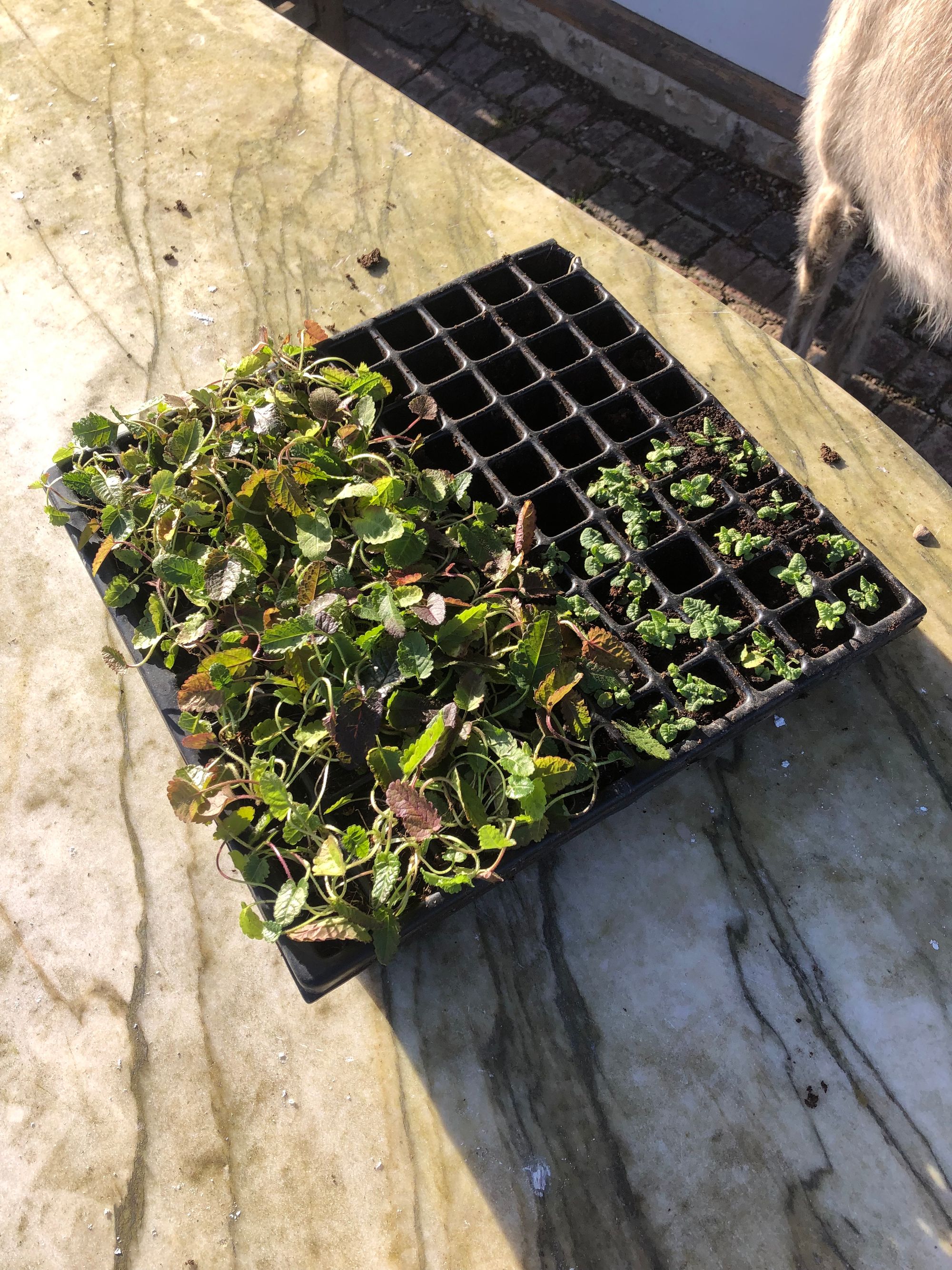
The other plant that I am keen to naturalise is Tulipa Sprengeri, which requires a far bigger investment, and takes a long time to flower from seed, but our late friend, Gigi Crompton had swathes of both cowslips and Sprengeri in her garden in Swaffham Bulbeck where we used to live. Both flourish in alkaline soil.
I bought 10 small tulip plants from Special Plants Nursery (www.specialplants.net) near Bath for almost £20.00 and am nurturing them in a pan. Derry Watkins, the presiding genius of Special Plant also sells packs of seeds for £2.50 from a wide and interesting list, both online and a well illustrated catalogue. During the unseasonably warm weather in mid-March, I had a seedling disaster caused by leaving our south-facing front porch door closed and forgetting about it. I won't ennumerate the casualties, suffice to say it was a horticultural Battle of the Somme, a lesson learned.
All can be replaced, but I do need a different set up for propagation. In the meantime, I have been sorting the vegetable garden. Purple sprouting broccoli sown last summer in a fruit cage to thwart the cabbage whites, the one butterfly that does not face imminent extinction, is giving us 2-3 cuts a week. The trick, that I have yet to master, is to find early and late varieties to prolong the season. The date of sowing doesn't seem to have anything to do with it, as they all head into winter ready to send out flowering shoots in spring, but some seem coded to strut their stuff in february, while others will hold of until the end of April.
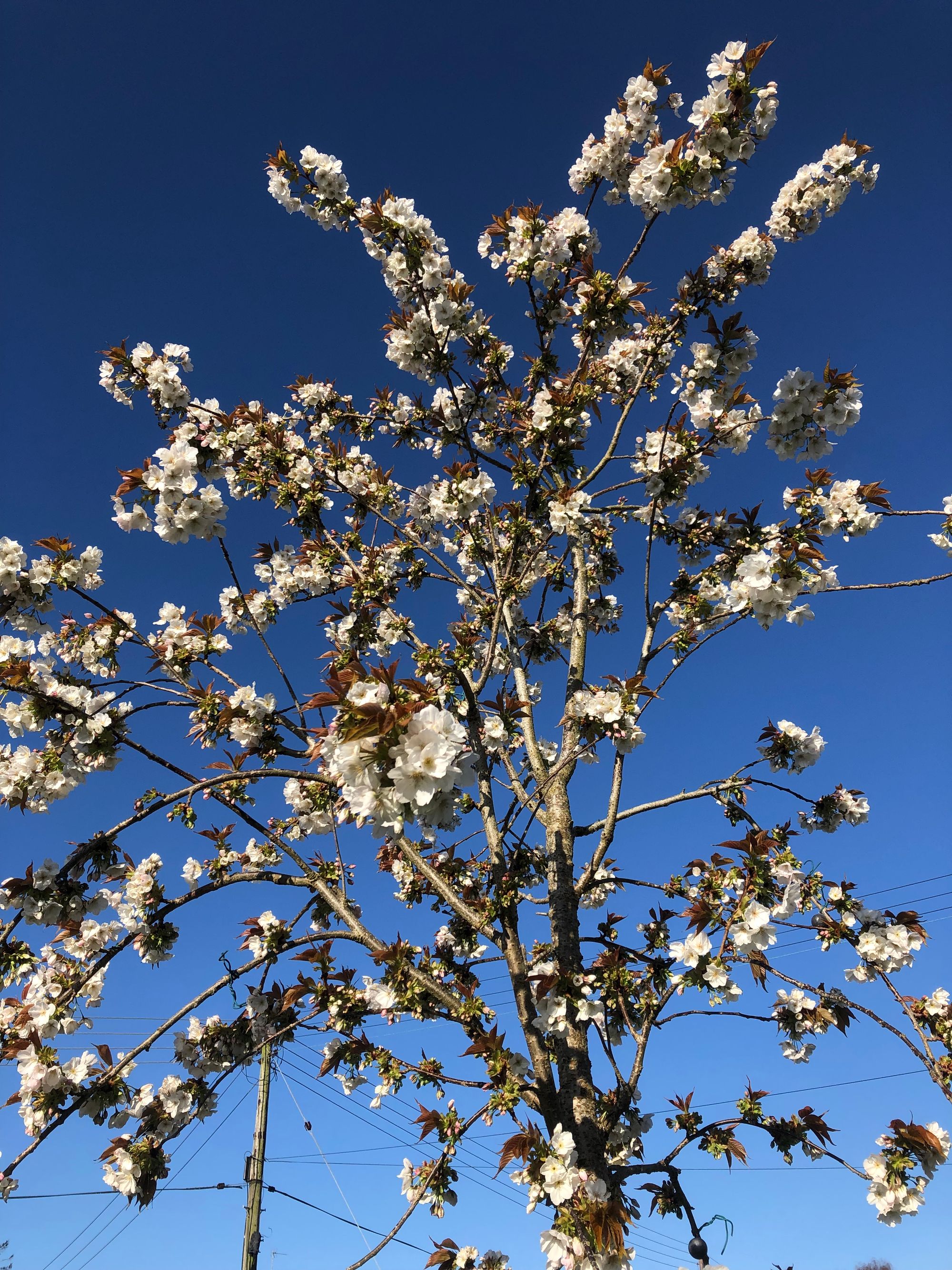
The largest single investment in a single plant was buying a six-metre high Tai Haku cherry tree just before lockdown. We bought it from majestictrees.co.uk, near St Albans three years ago, with great trepidation. We chose Majestic because their system of regular root pruning encourages a healthy ball of fibrous roots. We chose the Tai Haku, also known as the Great White Cherry, because we had just read, "Cherry Ingram, the Englishman Who Saved Japan's Blossoms" by Naoko Abe. This is wonderful read, telling you as much about Japan and the historical and cultural significance of Prunus Serrulata, as it does about Collingwood Ingram. The Tai Haku had been lost in Japan but Ingram found it growing in a Sussex garden and was able to see it re-established in its native habitat. Its flowers are single and up to five centimetres across.
It cost more to transport the tree from St Albans to West Dorset than to actually buy it. The tree went into a carefully prepared hole in December 2019, two metres across, and back-filled with Sylva Grow compost. My father always said, "Spend twice as much on the hole as you do on the tree." We staked it and watered it copiously and regularly through its first two summers. In its first year, just bursting into leaf was a hopeful sign. Last year it encouraged us with a thin scattering of flowers, and this year, it all seems worth it.
I will try to follow up with less of a break, but here are two more book recommendations, both relevant to gardeners. The first is Otherlands, by Thomas Halliday, which is an illustrated exploration of deep time. He takes the reader back to some spot on the earth's surface, 20,000 years ago in Alaska, 4 million years ago in Kenya, 6 million years ago in Italy, and so on; he then describes the local flora and fauna appropriate to the time and place, and also the gigantic forces that are driving spectacular environmental changes, such as the opening and closing of the straits of Gibraltar. For me, the most sobering chapter dealt with the asteroid strike in Yucatan, Mexico, that brought the Cretaceous period to a close, and wiped out 75% of life on Earth 66 million years ago. The other book, which I have only started and has completely captivated me, is Horizons, a Global History of Science, by James Poskett, which upends the Eurocentric narrative that I grew up with. The impression created by the botanical gardens that Cortez found in Mexico was particularly interesting, as it changed the way we thought about, and classified plants, paving the way for the taxonomic revolution led by Carl Linnaeus in the 18th century. There is much more to the book than that, but I have been interested in Latin American History since I first went to Peru in 1966, and this book opened an entirely new window for me.